
Table of Contents
The Verification Tax: The Hidden Cost of Software Engineering
There is a hidden cost appended to every pull request, every late-night deployment, and every complex architectural decision you make. We call it the Verification Tax. In traditional economics, a tax is a monetary deduction. In the high-velocity, logic-driven world of modern software engineering, this tax is levied directly against your neurobiology.
By 2026, the baseline expectation for a senior engineer has fundamentally shifted. We are no longer simply writing code; we are presiding over massive, multi-tiered AI ecosystems, validating LLM outputs, and managing highly complex, interoperable health networks using standards like Fast Healthcare Interoperability Resources (FHIR). This constant state of validation—the neurological friction of ensuring that a machine’s logic operates perfectly within human constraints—is causing an unprecedented spike in cognitive fatigue. Your brain is running a background process that never halts.
The “Hero Architect” model—fueled by excessive caffeine, 14-hour sprints, and a blatant disregard for circadian rhythms—has officially reached the end of its lifecycle. It is a deprecated system. The data is unequivocal: attempting to perpetually overclock your physiological hardware will result in a catastrophic, unrecoverable system crash. The solution? We are moving from reactive disaster recovery to proactive, real-time telemetry.

The Rise of the Biological ‘Digital Twin’
In cloud architecture, a “Digital Twin” is a virtual representation of a physical system—a server farm, a supply chain, or an IoT network—used to run prognostic simulations. If you push an update to the Digital Twin and the simulated server spikes in temperature and crashes, you know not to push that update to production.
In 2026, the breakthrough in tech-wellness is the Biological Digital Twin. We have finally gained enough sensor fidelity to create real-time, predictive models of our own metabolic and neurological state.
Beyond Basic Telemetry: Ambient Interoperability
Just five years ago, “biohacking” meant manually checking your heart rate after a workout or looking at your sleep score the morning after. That was asynchronous, lagging data. It was like reading a server log 12 hours after the site went down. Today, health tech implies Ambient Neuro-sensing.
We are talking about multi-sensor integration where your Continuous Glucose Monitor (CGM), your transdermal cortisol patch, and your neuro-headband don’t just collect data—they talk to each other via secure, API-driven health ecosystems. This data forms a localized AI model—your Biological Digital Twin. This twin doesn’t just record what happened; it simulates what will happen. If you begin a heavy coding sprint right after a high-glycemic meal, your Digital Twin flags the impending metabolic crash and alerts your IDE to block notifications, giving you a 45-minute window to close out your logic loop before cognitive failure occurs.
Hyper-Personalization vs. The Generic Protocol
The generic wellness advice of the 2010s (“drink water, stand up, take deep breaths”) was the equivalent of telling a sysadmin to “just try rebooting it.” It lacked diagnostic specificity.
The 2026 paradigm is built on Hyper-Personalization. Your AI health agent knows that your specific nervous system enters a state of sympathetic arousal (fight or flight) when your Interkey Interval (IKI) drops below a certain millisecond threshold. It knows that for you, a sudden drop in Heart Rate Variability (HRV) at 3:00 PM requires a 10-minute Non-Sleep Deep Rest (NSDR) protocol, not another cup of coffee. This is precision-guided recovery.
Nervous System Regulation: The New ‘Root Access’
For the software engineer, the brain is the ultimate Integrated Development Environment (IDE), and the nervous system is the underlying Operating System. You cannot optimize the application if the OS is fundamentally unstable.
The Polyvagal Imperative
We used to think of burnout as a purely emotional state. We now understand it as a structural failure in the Autonomic Nervous System (ANS), specifically relating to vagal tone. Polyvagal theory has moved from academia to the engineer’s desk. When you are engaged in deep work but constantly interrupted by alerts, Slack messages, and PagerDuty alarms, your system gets stuck in a loop of micro-traumas.
Advanced bio-wearables in 2026 track your vagal tone in real-time. If your “biological ping rate” to the prefrontal cortex begins to drop—signaling that your brain is reallocating resources away from logical thought toward survival mode—the system intervenes. This is why ambient environmental control (dynamic lighting, noise-canceling auditory stimulation, and ergonomic micro-adjustments) is no longer a luxury; it is basic prophylactic maintenance.
Mitigating ‘Digital Eye Strain’ and Environmental Glare
Your optic nerve is physically an extension of your brain. Staring into high-glare environments doesn’t just cause “tired eyes”; it sends continuous stress signals directly to your amygdala. Managing your optical input—using advanced asymmetric lighting and precision blue-light filtering—is a critical method for downregulating the nervous system. If you are coding without managing optical glare, you are artificially increasing your cortisol levels with every hour you work.
The Software Engineer’s Competitive Advantage in HealthTech
There is a unique irony in 2026: The same professionals who are building the infrastructure for global, interoperable, AI-driven healthcare are often the worst at maintaining their own biological infrastructure. However, the IT professional has a massive competitive advantage when it comes to mastering this new era of biohacking.
Algorithmic Empathy
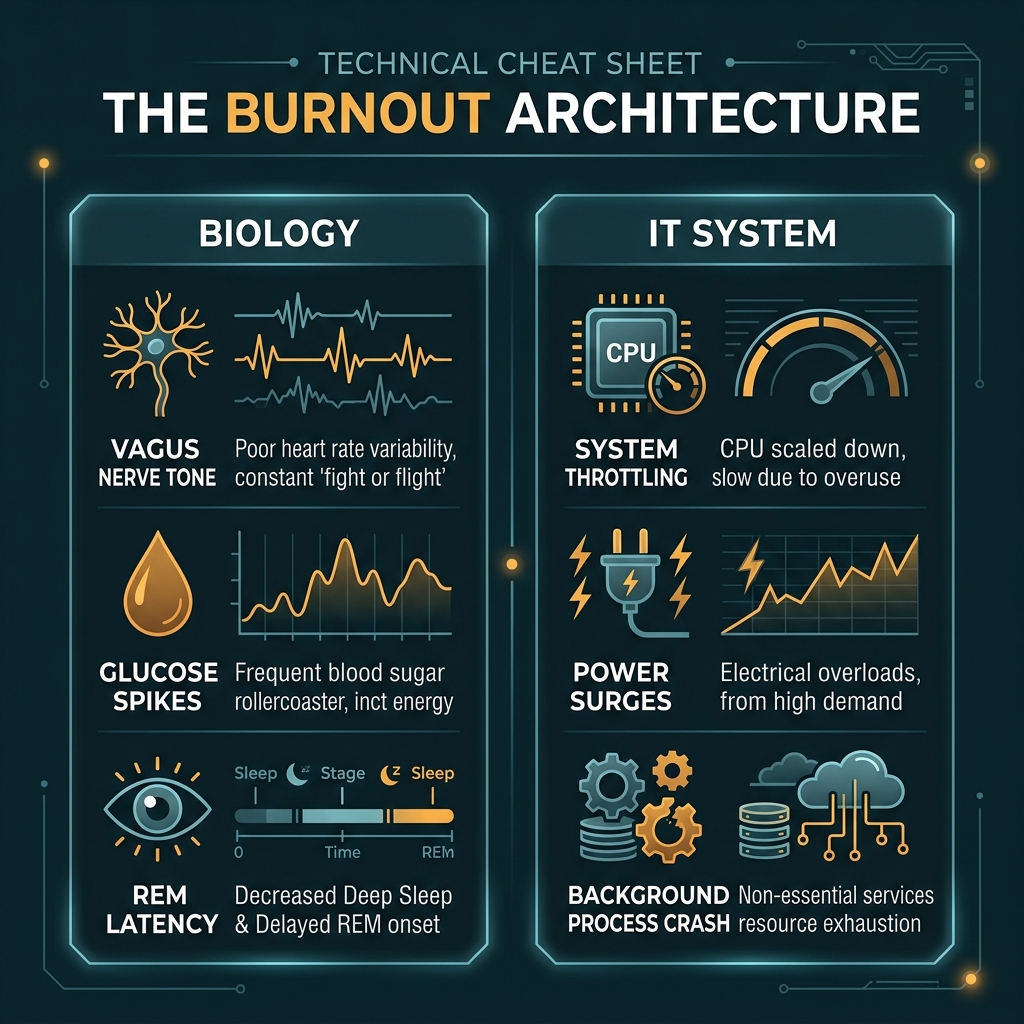
As engineers, we naturally understand systems thinking. We understand feedback loops, logic gates, and latency. By simply mapping IT concepts onto physiological realities, the entire domain of wellness becomes a technical puzzle rather than a mystical practice. When you understand that a “glucose spike” is a localized power surge that will inevitably lead to a “background process crash” (an energy slump), you stop relying on willpower and start relying on systems design.
The Low-Code/No-Code Bio-Automation
With the rise of robust APIs on health platforms, engineers can now use low-code integrators to wire their biology to their environment. Imagine a custom script that dims your smart lights, turns on a specific binaural beat frequency on your audio system, and marks you as “Away” on Slack the moment your smartwatch detects your HRV dropping below your personalized threshold. This isn’t science fiction; this is an afternoon project in 2026.
Executing the Paradigm Shift: From Tracking to Intervening
The goal is no longer to just “know” that you slept poorly or that you are stressed. The goal is Active Intervention. If your Biological Digital Twin indicates a high probability of cognitive failure by 2:00 PM, what is the protocol?
It means adopting the 90-Minute Sprint protocol reliably. It means employing structural ergonomics that prevent the pooling of blood in the lower extremities (stagnation) while you debug. It means treating your sleep architecture with the same rigorous QA process that you apply to pre-production code.
The software engineers who will lead the massive AI-infrastructure projects of the late 2020s won’t be the ones pulling the most all-nighters. They will be the Bio-Linked Conductors—the professionals who have engineered their own physiology to handle immense cognitive loads with zero latency.
Stop paying the Verification Tax with your health. Audit your hardware. Patch your OS. Refactor your life.
Medical Disclaimer: The information provided in this article is for educational and informational purposes only and is not intended as medical advice. Always consult with a qualified healthcare professional before making any changes to your health regimen, bio-hacking protocols, or using new wearable devices.