
Table of Contents
The Epidemic of ‘AI Brain Fry’ in Software Engineering
When generative AI and coding copilots first hit the mainstream, the promise was singular: velocity. AI was supposed to be the ultimate junior developer, taking over the boilerplate, writing the unit tests, and leaving the senior engineer free to focus on architecture and deep logic. But in April 2026, the reality on the ground inside major tech firms is revealing a starkly different physiological truth. The integration of AI hasn’t just increased code output; it has fundamentally altered the neuro-biological demands of software engineering. We are facing a critical epidemic of what researchers are terming “AI Brain Fry.”
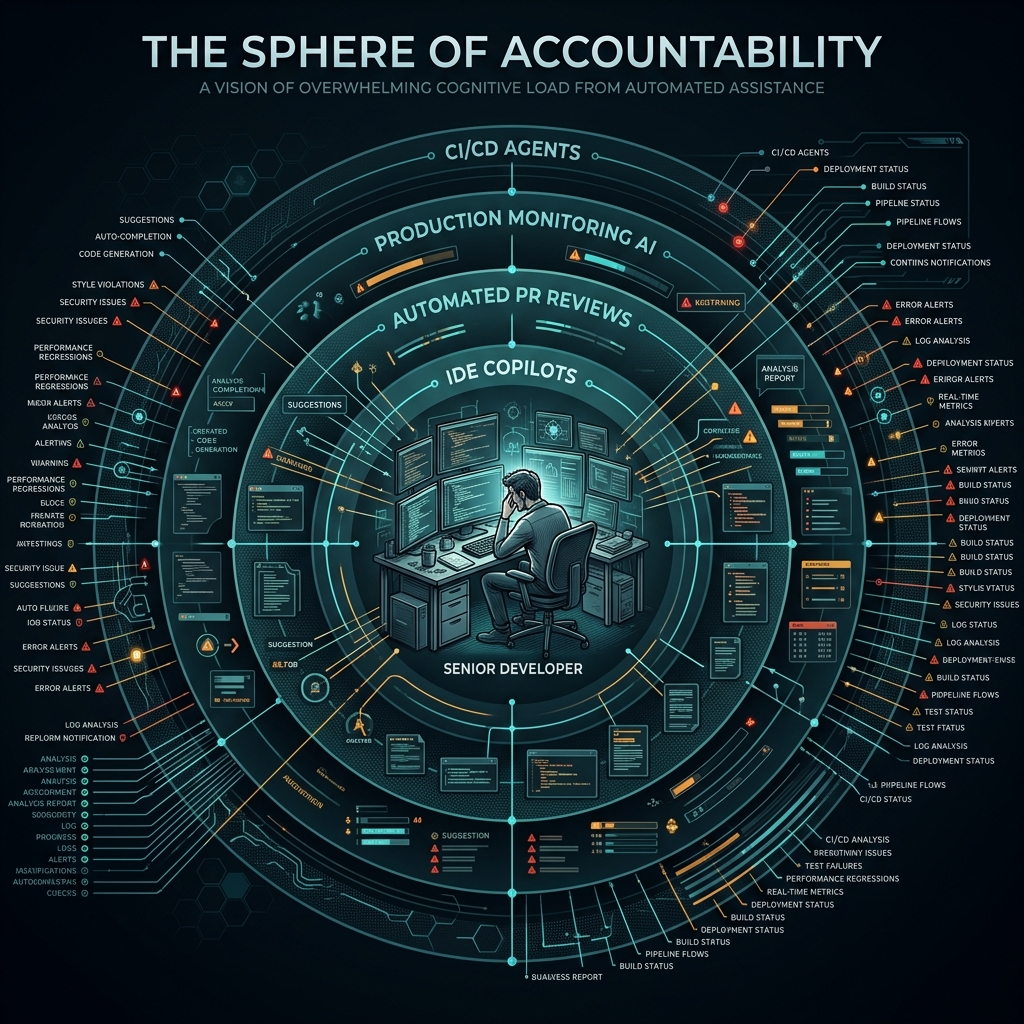
Unlike classic developer fatigue—which usually resulted from long hours of continuous, logical problem-solving—this new variant of cognitive overload is characterized by decision fatigue and context collapse. It is not the exhaustion of focused work; it is the exhaustion of oversight. When you are managing an IDE Copilot, a CI/CD automated review agent, a production monitoring AI, and an automated deployment pipeline, you are no longer just an engineer. You are an air traffic controller for a fleet of brilliant but highly unpredictable machines.

The Expanding ‘Sphere of Accountability’
The core mechanism driving this cognitive load is the expanding Sphere of Accountability. In 2020, you were accountable for the code you physically typed. In 2026, you are accountable for code generated by your copilot, the security vulnerabilities flagged (or missed) by your AST agent, and the automated pull requests generated by dependency bots.
This creates a psychological phenomenon known as continuous partial attention. Because an AI agent can generate 500 lines of complex React components in three seconds, the human bottleneck has moved from generation to verification. Reading and verifying code requires a completely different, and arguably more taxing, neural pathway than writing code from scratch. Your prefrontal cortex must simulate the AI’s logic, look for edge cases the model missed, and hold the entire system state in working memory. When this process is repeated hundreds of times a day, the resulting “AI Brain Fry” manifests as profound brain fog, a sudden inability to perform deep work, and high-frequency context-switching latency.
The False Promise of ‘Time Saved’
Recent studies from health-tech analytics firms looking at IT professional wellness indicate that while generative AI saves an average of 14 hours a week in manual typing, the stress and burnout markers (measured via cortisol and HRV trackers) among senior engineers have actually increased by 16-18%. The time saved isn’t being used for recovery; it’s being filled with more verification tasks, leading to an overclocked nervous system that never gets a chance to down-regulate.
Mitigating Cognitive Overload: The 2026 Defense Protocols
If you are experiencing AI Brain Fry, traditional advice like “take a screen break” or “drink more water” is woefully inadequate. We are dealing with structural, neurological fatigue. The solution requires a systems-based approach—treating your own brain as a critically constrained resource that requires strict resource management.
Protocol 1: Strict Defragmentation Periods
When you are overseeing multiple AI agents, your short-term memory acts like highly fragmented RAM. To clear this cache, you must schedule rigid “Defragmentation Periods.” This means completely disconnecting from the Sphere of Accountability for periods of 20-30 minutes. Advanced developers are using bio-hacking protocols like Non-Sleep Deep Rest (NSDR) or Theta-wave audio synchronization to forcefully shift their brain waves from high-stress Beta into relaxed Alpha and Theta states. This clears the accumulated neuro-chemical stress of continuous verification.
Protocol 2: Context-Aware vs. Fragmented Tooling
The health-conscious engineer must ruthless audit their AI tooling. A tool that generates code but requires massive context-shifting to fix is a net-negative for your cognitive health. The trend in late-2026 is toward deeply integrated, context-aware copilots (like the latest iterations of Cursor) that understand the entire repository architecture. If a tool requires you to hold more than 3 variables in your working memory just to verify its output, it is a risk variable. Offload the context to the machine, not just the typing.
Protocol 3: Neurological Load Balancing
Just as you wouldn’t route 100% of your traffic to a single server instance, you cannot route 100% of your cognitive load to high-intensity verification tasks all day. Adopt “Neurological Load Balancing.” Structure your day so that high-friction verification tasks are batched during your peak metabolic windows (typically the first 3 hours after waking). Use the subsequent hours for lower-stakes architectural planning or analogue whiteboarding, giving your prefrontal cortex the necessary downtime to physically rebuild ATP (cellular energy) reserves.
The Next Evolution: Empathic AI Coaching
Interestingly, the cure for AI-induced burnout may involve specialized, highly regulated AI. We are seeing the rise of Empathic Generative AI Coaches within corporate wellness programs. Instead of asking you to fill out a static wellness survey, these localized, privacy-first agents monitor your commit frequency, key-press latency, and meeting density. When they detect the biometric signature of “AI Brain Fry,” they intervene—locking out non-critical notifications, suggesting automated out-of-office blocks, and guiding the developer through rapid physiological resets.
As we navigate this new era of software engineering, we must remember that the most complex, most fragile, and most expensive operating system in your entire architecture is the one sitting between your ears. It is time to patch your cognitive OS. Manage your Sphere of Accountability before it manages you.
Medical Disclaimer: The information provided in this article is for educational and informational purposes only and is not intended as medical advice. Always consult with a qualified healthcare professional before making any changes to your health regimen, bio-hacking protocols, or using new wearable devices.