
Table of Contents
- 1 Dopamine Depletion in 2026: The Neurochemical Cost of Context Layering and the Vagus Nerve Reset
- 1.1 The Biological Limits: Human Working Memory vs. Infinite Context Windows
- 1.2 The Dopamine Trap: Understanding Neurochemical Layering
- 1.3 Neuro-Ergonomic Audit: Conventional vs. Agentic Paradigms
- 1.4 Visualizing the Cycle: The Vagus Nerve Reset
- 1.5 Hacking the Autonomic System: Vagal Tone and Tech
- 1.6 Code as Therapy: The Local Vagus Daemon
- 1.7 The Dopamine Restoration Protocol
- 1.8 People Also Ask
- 1.9 Conclusion: Protect Your Biological Runtime
Dopamine Depletion in 2026: The Neurochemical Cost of Context Layering and the Vagus Nerve Reset
The landscape of software engineering in 2026 is defined not by the code we write, but by the neurochemical cost of managing the synthetic minds that write it for us. We have entered an era of ‘Agentic Overload,’ where developers no longer act strictly as creators, but rather as high-velocity logic orchestrators. This monumental shift in the daily rhythm of a developer has given rise to a silent, profound crisis in cognitive ergonomics, primarily manifesting as critical dopamine depletion and severe strain on human working memory limits. To sustainably operate in a modern, hyper-accelerated tech stack, we must systematically deconstruct and protect our biological runtime.The landscape of software engineering in 2026 is defined not by the code we write, but by the neurochemical cost of managing the synthetic minds that write it for us. We have entered an era of ‘Agentic Overload,’ where developers no longer act strictly as creators, but rather as high-velocity logic orchestrators. This monumental shift in the daily rhythm of a developer has given rise to a silent, profound crisis in cognitive ergonomics, primarily manifesting as critical dopamine depletion and severe strain on human working memory limits. To sustainably operate in a modern, hyper-accelerated tech stack, we must systematically deconstruct and protect our biological runtime.The landscape of software engineering in 2026 is defined not by the code we write, but by the neurochemical cost of managing the synthetic minds that write it for us. We have entered an era of ‘Agentic Overload,’ where developers no longer act strictly as creators, but rather as high-velocity logic orchestrators. This monumental shift in the daily rhythm of a developer has given rise to a silent, profound crisis in cognitive ergonomics, primarily manifesting as critical dopamine depletion and severe strain on human working memory limits. To sustainably operate in a modern, hyper-accelerated tech stack, we must systematically deconstruct and protect our biological runtime.
When we talk about developer wellness in this highly integrated paradigm, we’re not just talking about standing desks or blue-light blocking glasses. We are talking about fundamental neurobiology. Every time an AI agent returns a syntactically perfect but logically flawed snippet, your brain experiences a miniature crisis. It expects the reward of completion (a dopamine hit) but instead receives a complex, high-friction auditing task (an extraneous cognitive load penalty). Multiply this micro-interaction by hundreds of times a day, and the result is a systemic downregulation of your dopamine receptors, leading to chronic apathy, focus jitter, and an overarching feeling of ‘hollow fatigue’ that traditional rest cannot cure.When we talk about developer wellness in this highly integrated paradigm, we’re not just talking about standing desks or blue-light blocking glasses. We are talking about fundamental neurobiology. Every time an AI agent returns a syntactically perfect but logically flawed snippet, your brain experiences a miniature crisis. It expects the reward of completion (a dopamine hit) but instead receives a complex, high-friction auditing task (an extraneous cognitive load penalty). Multiply this micro-interaction by hundreds of times a day, and the result is a systemic downregulation of your dopamine receptors, leading to chronic apathy, focus jitter, and an overarching feeling of ‘hollow fatigue’ that traditional rest cannot cure.When we talk about developer wellness in this highly integrated paradigm, we’re not just talking about standing desks or blue-light blocking glasses. We are talking about fundamental neurobiology. Every time an AI agent returns a syntactically perfect but logically flawed snippet, your brain experiences a miniature crisis. It expects the reward of completion (a dopamine hit) but instead receives a complex, high-friction auditing task (an extraneous cognitive load penalty). Multiply this micro-interaction by hundreds of times a day, and the result is a systemic downregulation of your dopamine receptors, leading to chronic apathy, focus jitter, and an overarching feeling of ‘hollow fatigue’ that traditional rest cannot cure.
The Biological Limits: Human Working Memory vs. Infinite Context Windows
To understand the root cause of this depletion, we must look at the strict biological limitations of Human Working Memory. For decades, cognitive science operated under the ‘Miller’s Law’ assumption—that human working memory could hold approximately 7 (plus or minus 2) items. In the 2026 engineering context, where ‘items’ are highly complex state dependencies, asynchronous callbacks, and multi-agent context parameters, modern neuro-ergonomic studies have revised this number down to a strict 4. Your biological ‘RAM’ is incredibly small.To understand the root cause of this depletion, we must look at the strict biological limitations of Human Working Memory. For decades, cognitive science operated under the ‘Miller’s Law’ assumption—that human working memory could hold approximately 7 (plus or minus 2) items. In the 2026 engineering context, where ‘items’ are highly complex state dependencies, asynchronous callbacks, and multi-agent context parameters, modern neuro-ergonomic studies have revised this number down to a strict 4. Your biological ‘RAM’ is incredibly small.To understand the root cause of this depletion, we must look at the strict biological limitations of Human Working Memory. For decades, cognitive science operated under the ‘Miller’s Law’ assumption—that human working memory could hold approximately 7 (plus or minus 2) items. In the 2026 engineering context, where ‘items’ are highly complex state dependencies, asynchronous callbacks, and multi-agent context parameters, modern neuro-ergonomic studies have revised this number down to a strict 4. Your biological ‘RAM’ is incredibly small.
Conversely, the AI models we interface with daily possess context windows reaching into the millions of tokens. This creates a severe ‘Impedance Mismatch.’ The LLM surfaces a 500-line solution that perfectly satisfies its massive context array. To audit this, the human engineer must load the entire state representation into their 4-slot working memory. This requires aggressive context swapping, mental fragmentation, and a continuous overriding of short-term cache. The neurological effort required to verify synthetic logic is mathematically proven to be higher than the effort required to author it from first principles. If you are neglecting your Sleep, this memory cache clears inefficiently, compounding the damage.Conversely, the AI models we interface with daily possess context windows reaching into the millions of tokens. This creates a severe ‘Impedance Mismatch.’ The LLM surfaces a 500-line solution that perfectly satisfies its massive context array. To audit this, the human engineer must load the entire state representation into their 4-slot working memory. This requires aggressive context swapping, mental fragmentation, and a continuous overriding of short-term cache. The neurological effort required to verify synthetic logic is mathematically proven to be higher than the effort required to author it from first principles. If you are neglecting your Sleep, this memory cache clears inefficiently, compounding the damage.Conversely, the AI models we interface with daily possess context windows reaching into the millions of tokens. This creates a severe ‘Impedance Mismatch.’ The LLM surfaces a 500-line solution that perfectly satisfies its massive context array. To audit this, the human engineer must load the entire state representation into their 4-slot working memory. This requires aggressive context swapping, mental fragmentation, and a continuous overriding of short-term cache. The neurological effort required to verify synthetic logic is mathematically proven to be higher than the effort required to author it from first principles. If you are neglecting your Sleep, this memory cache clears inefficiently, compounding the damage.
The Dopamine Trap: Understanding Neurochemical Layering
Software development has always been a dopamine-driven profession. The cycle is well-documented: identify a bug, feel the tension of the puzzle, deduce the root cause, deploy the fix, and receive a flood of dopamine as the test suite glows green. This natural cycle is ‘Autotelic’—the work is its own reward. The dopamine released is commensurate with the intrinsic cognitive effort expended. The balance is neurologically stable, promoting sustainable, deep-work sessions that can last for hours.Software development has always been a dopamine-driven profession. The cycle is well-documented: identify a bug, feel the tension of the puzzle, deduce the root cause, deploy the fix, and receive a flood of dopamine as the test suite glows green. This natural cycle is ‘Autotelic’—the work is its own reward. The dopamine released is commensurate with the intrinsic cognitive effort expended. The balance is neurologically stable, promoting sustainable, deep-work sessions that can last for hours.Software development has always been a dopamine-driven profession. The cycle is well-documented: identify a bug, feel the tension of the puzzle, deduce the root cause, deploy the fix, and receive a flood of dopamine as the test suite glows green. This natural cycle is ‘Autotelic’—the work is its own reward. The dopamine released is commensurate with the intrinsic cognitive effort expended. The balance is neurologically stable, promoting sustainable, deep-work sessions that can last for hours.
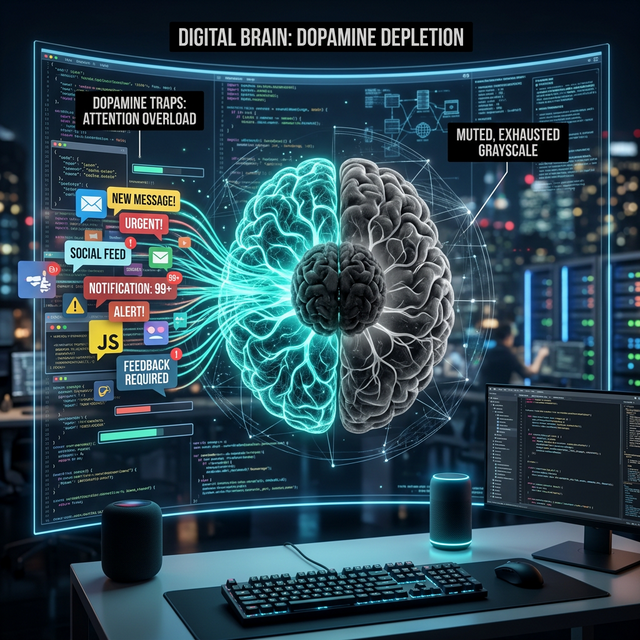
Agentic AI shatters this cycle. The new loop is known as ‘Dopamine Layering.’ You write a prompt, instantly receive code, and experience a micro-spike of dopamine from the sheer speed of the delivery. The brain anticipates the puzzle is solved. However, the code must then be scrutinized. The test fails. The dopamine crashes below the baseline. You prompt again. Spike. Crash. This extreme sinusoidal neurochemical activity overstimulates the dopamine receptors. To protect themselves, the receptors downregulate. Consequently, your baseline dopamine drops. Tasks that used to be enjoyable suddenly feel insurmountable. You begin unconsciously seeking faster, cheaper dopamine hits—like switching tabs to social media or incessantly checking metrics dashboards—while your actual engineering productivity grinds to a halt.Agentic AI shatters this cycle. The new loop is known as ‘Dopamine Layering.’ You write a prompt, instantly receive code, and experience a micro-spike of dopamine from the sheer speed of the delivery. The brain anticipates the puzzle is solved. However, the code must then be scrutinized. The test fails. The dopamine crashes below the baseline. You prompt again. Spike. Crash. This extreme sinusoidal neurochemical activity overstimulates the dopamine receptors. To protect themselves, the receptors downregulate. Consequently, your baseline dopamine drops. Tasks that used to be enjoyable suddenly feel insurmountable. You begin unconsciously seeking faster, cheaper dopamine hits—like switching tabs to social media or incessantly checking metrics dashboards—while your actual engineering productivity grinds to a halt.Agentic AI shatters this cycle. The new loop is known as ‘Dopamine Layering.’ You write a prompt, instantly receive code, and experience a micro-spike of dopamine from the sheer speed of the delivery. The brain anticipates the puzzle is solved. However, the code must then be scrutinized. The test fails. The dopamine crashes below the baseline. You prompt again. Spike. Crash. This extreme sinusoidal neurochemical activity overstimulates the dopamine receptors. To protect themselves, the receptors downregulate. Consequently, your baseline dopamine drops. Tasks that used to be enjoyable suddenly feel insurmountable. You begin unconsciously seeking faster, cheaper dopamine hits—like switching tabs to social media or incessantly checking metrics dashboards—while your actual engineering productivity grinds to a halt.
Neuro-Ergonomic Audit: Conventional vs. Agentic Paradigms
| Cognitive Metric | Traditional Workflow (2020) | Agentic Workflow (2026) |
|---|---|---|
| Dopamine Baseline Stability | High (Steady release during coding) | Critical (Rapid spikes & crashes) |
| Working Memory Evictions/Hour | ~40 (Controlled context switching) | ~320+ (Aggressive AI auditing) |
| Extraneous Load Dominance | 15% of mental effort | 65% of mental effort |
| Vagal Tone Recovery Rate | Natural (evenings/weekends) | Severely Impaired (Continuous stress) |
Visualizing the Cycle: The Vagus Nerve Reset
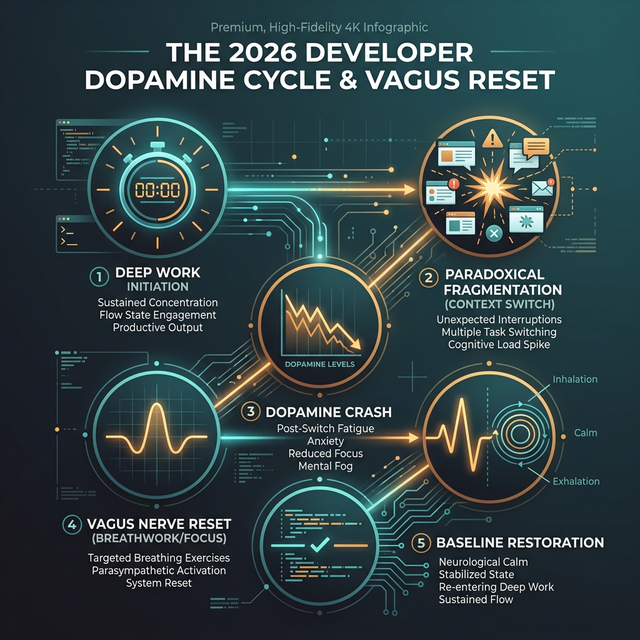
To arrest the cycle of dopamine depletion and working memory burnout, 2026 cognitive ergonomics focuses heavily on the Autonomic Nervous System, specifically the Vagus Nerve. The infographic below maps the exact physiological reality of a modern developer’s session and introduces the Vagus Nerve Reset—a protocol designed to force your biological hardware back into a parasympathetic (‘rest and digest’) state, clearing the synthetic load and restoring baseline dopamine synthesis.To arrest the cycle of dopamine depletion and working memory burnout, 2026 cognitive ergonomics focuses heavily on the Autonomic Nervous System, specifically the Vagus Nerve. The infographic below maps the exact physiological reality of a modern developer’s session and introduces the Vagus Nerve Reset—a protocol designed to force your biological hardware back into a parasympathetic (‘rest and digest’) state, clearing the synthetic load and restoring baseline dopamine synthesis.
Hacking the Autonomic System: Vagal Tone and Tech
The Vagus Nerve is the superhighway of your parasympathetic nervous system. It connects your brain stem to your heart, lungs, and gut. When you are auditing heavily abstracted, hallucinated AI logic, your body interprets this high-friction mental effort as a physical threat. The sympathetic nervous system kicks in: shallow breathing, elevated heart rate, and an influx of cortisol. Over time, this chronic stress damages your ‘Vagal Tone’—your body’s ability to efficiently transition back to a relaxed state. Engineers with poor Vagal Tone suffer from constant low-grade inflammation, poor decision matrices, and an inability to achieve ‘Deep Work’ states.The Vagus Nerve is the superhighway of your parasympathetic nervous system. It connects your brain stem to your heart, lungs, and gut. When you are auditing heavily abstracted, hallucinated AI logic, your body interprets this high-friction mental effort as a physical threat. The sympathetic nervous system kicks in: shallow breathing, elevated heart rate, and an influx of cortisol. Over time, this chronic stress damages your ‘Vagal Tone’—your body’s ability to efficiently transition back to a relaxed state. Engineers with poor Vagal Tone suffer from constant low-grade inflammation, poor decision matrices, and an inability to achieve ‘Deep Work’ states.The Vagus Nerve is the superhighway of your parasympathetic nervous system. It connects your brain stem to your heart, lungs, and gut. When you are auditing heavily abstracted, hallucinated AI logic, your body interprets this high-friction mental effort as a physical threat. The sympathetic nervous system kicks in: shallow breathing, elevated heart rate, and an influx of cortisol. Over time, this chronic stress damages your ‘Vagal Tone’—your body’s ability to efficiently transition back to a relaxed state. Engineers with poor Vagal Tone suffer from constant low-grade inflammation, poor decision matrices, and an inability to achieve ‘Deep Work’ states.
Stimulating the Vagus Nerve is the only physiological method to instantly halt the dopamine crash cycle. By engaging long, slow, diaphragmatic exhalations, you manually signal to the brain stem that the ‘threat’ (the complex code block) has passed. The heart rate descends, heart rate variability (HRV) increases, and the prefrontal cortex is brought back online. In elite 2026 engineering pods, Vagus Nerve stimulation—often through non-invasive transcutaneous auricular VNS (taVNS) ear-clip devices or strictly enforced physiological sighing intervals—is as common as a mechanical keyboard.Stimulating the Vagus Nerve is the only physiological method to instantly halt the dopamine crash cycle. By engaging long, slow, diaphragmatic exhalations, you manually signal to the brain stem that the ‘threat’ (the complex code block) has passed. The heart rate descends, heart rate variability (HRV) increases, and the prefrontal cortex is brought back online. In elite 2026 engineering pods, Vagus Nerve stimulation—often through non-invasive transcutaneous auricular VNS (taVNS) ear-clip devices or strictly enforced physiological sighing intervals—is as common as a mechanical keyboard.Stimulating the Vagus Nerve is the only physiological method to instantly halt the dopamine crash cycle. By engaging long, slow, diaphragmatic exhalations, you manually signal to the brain stem that the ‘threat’ (the complex code block) has passed. The heart rate descends, heart rate variability (HRV) increases, and the prefrontal cortex is brought back online. In elite 2026 engineering pods, Vagus Nerve stimulation—often through non-invasive transcutaneous auricular VNS (taVNS) ear-clip devices or strictly enforced physiological sighing intervals—is as common as a mechanical keyboard.
Code as Therapy: The Local Vagus Daemon
You cannot rely on willpower to manage your neurochemistry. You must automate your cognitive safeguards. We created a local daemon—a Python script that monitors your keyboard interrupts and error cluster outputs. When it detects rapid, frustrated syntax execution (a key marker of dopamine-driven stress seeking), it locks the screen and forces a Vagus Nerve reset breathing protocol. It pairs exceptionally well with monitoring your Calories and Caffeine intake to ensure you are biologically fueled for the audit.
import time
import os
from pynput import keyboard

# 2026 Vagus Nerve Reset Daemon
# Monitors rapid keystroke entropy (frustration typing) and forces a parasympathetic reset.

ENTROPY_THRESHOLD = 8.5
keystroke_timestamps = []

def analyze_entropy():
    if len(keystroke_timestamps) < 50:
        return 0
    # Calculate intervals between strokes
    intervals = [keystroke_timestamps[i] - keystroke_timestamps[i-1] for i in range(1, len(keystroke_timestamps))]
    avg_interval = sum(intervals) / len(intervals)

    # If standard deviation represents "bashing" keys, spike entropy
    variance = sum((x - avg_interval) ** 2 for x in intervals) / len(intervals)
    return 10.0 if variance < 0.01 and avg_interval < 0.1 else 2.0

def on_press(key):
    global keystroke_timestamps
    current_time = time.time()
    keystroke_timestamps.append(current_time)

    # Keep sliding window of last 50 strokes
    if len(keystroke_timestamps) > 50:
        keystroke_timestamps.pop(0)

    entropy_score = analyze_entropy()

    if entropy_score > ENTROPY_THRESHOLD:
        print("\n\n[CRITICAL] Dopamine depletion pattern detected (High-Entropy Keyboard Bashing).")
        print("[ACTION] Engaging Vagus Nerve Reset Protocol.")
        print("-> Inhale for 4 seconds...")
        time.sleep(4)
        print("-> Exhale deeply for 8 seconds (Activating parasympathetic bridge)...")
        time.sleep(8)
        print("[RESTORED] Vagal Tone stabilized. Resuming I/O.\n\n")
        keystroke_timestamps.clear() # Reset window

listener = keyboard.Listener(on_press=on_press)
listener.start()
print("Vagus Daemon: Active. Protecting Biological Runtime.")

while True:
    time.sleep(60)
The Dopamine Restoration Protocol
- Identify the Trap: Recognize when an AI prompt loop is causing a dopamine crash. If you prompt a synthetic agent more than 3 times for the same logic block without progress, abort.
- Enact Context Zero: Step entirely away from the IDE. Staring at the screen while blocked creates an infinite loop in your working memory cache.
- Vagus Bridging: Perform a double-inhale followed by a long, extended exhale. The extended exhale physically slows the heart and engages the Vagus nerve.
- Biological I/O Validation: Ensure your foundational metrics are sound. Check your BMI and dietary routines. Neurochemistry requires raw material to synthesize neurotransmitters.
- Tactical De-Abstraction: When returning to the code, manually write the function from scratch. The tactile, slow process of creation restores the healthy, autotelic dopamine cycle.
Furthermore, the implications of allowing developer neurochemistry to degrade unchecked are systemic. When a senior engineer’s dopamine baseline collapses, they no longer act as a mentor or architectural visionary. They regress into survival mode, writing defensive, overly abstracted logic just to appease the immediate demands of the sprint. By ignoring cognitive ergonomics, organizations are inadvertently funding the neurochemical collapse of their most valuable assets. We must pioneer a movement where ‘Mental Uptime’ is monitored with the exact same rigor and tooling as our server uptime. Implementing mandatory Vagus Nerve stimulation pauses, establishing dopamine-safe deep-work periods where AI auto-completion is strictly disabled, and training developers to recognize the biological symptoms of working memory eviction are not ‘perks’—they are the critical infrastructure of 2026 software engineering.Furthermore, the implications of allowing developer neurochemistry to degrade unchecked are systemic. When a senior engineer’s dopamine baseline collapses, they no longer act as a mentor or architectural visionary. They regress into survival mode, writing defensive, overly abstracted logic just to appease the immediate demands of the sprint. By ignoring cognitive ergonomics, organizations are inadvertently funding the neurochemical collapse of their most valuable assets. We must pioneer a movement where ‘Mental Uptime’ is monitored with the exact same rigor and tooling as our server uptime. Implementing mandatory Vagus Nerve stimulation pauses, establishing dopamine-safe deep-work periods where AI auto-completion is strictly disabled, and training developers to recognize the biological symptoms of working memory eviction are not ‘perks’—they are the critical infrastructure of 2026 software engineering.Furthermore, the implications of allowing developer neurochemistry to degrade unchecked are systemic. When a senior engineer’s dopamine baseline collapses, they no longer act as a mentor or architectural visionary. They regress into survival mode, writing defensive, overly abstracted logic just to appease the immediate demands of the sprint. By ignoring cognitive ergonomics, organizations are inadvertently funding the neurochemical collapse of their most valuable assets. We must pioneer a movement where ‘Mental Uptime’ is monitored with the exact same rigor and tooling as our server uptime. Implementing mandatory Vagus Nerve stimulation pauses, establishing dopamine-safe deep-work periods where AI auto-completion is strictly disabled, and training developers to recognize the biological symptoms of working memory eviction are not ‘perks’—they are the critical infrastructure of 2026 software engineering.Furthermore, the implications of allowing developer neurochemistry to degrade unchecked are systemic. When a senior engineer’s dopamine baseline collapses, they no longer act as a mentor or architectural visionary. They regress into survival mode, writing defensive, overly abstracted logic just to appease the immediate demands of the sprint. By ignoring cognitive ergonomics, organizations are inadvertently funding the neurochemical collapse of their most valuable assets. We must pioneer a movement where ‘Mental Uptime’ is monitored with the exact same rigor and tooling as our server uptime. Implementing mandatory Vagus Nerve stimulation pauses, establishing dopamine-safe deep-work periods where AI auto-completion is strictly disabled, and training developers to recognize the biological symptoms of working memory eviction are not ‘perks’—they are the critical infrastructure of 2026 software engineering.
People Also Ask
What are the symptoms of severely depleted dopamine in software engineers?
Symptoms include chronic procrastination on code reviews, loss of interest in personal coding projects, resorting to ‘brute-force’ logic instead of elegant abstraction, and a heightened dependency on caffeine or social media between compiling tasks.
How does the Vagus Nerve connect to coding performance?
The Vagus nerve controls your parasympathetic nervous system. When vagal tone is high, you recover quickly from stress. High vagal tone allows for sustained focus and emotional resilience when debugging complex, highly stressful system failures without triggering a panic response.
Why is Human Working Memory a bottleneck in 2026?
Because AI generates code that is incredibly dense and often lacks the ‘narrative’ progression a human uses when writing. To audit AI code, a human must parse all variables, states, and logic paths into their limited 4-slot working memory simultaneously, causing rapid cognitive overload.
Can you restore a crashed dopamine baseline?
Yes. By engaging in ‘Dopamine Fasting’—removing cheap, high-speed dopamine triggers (like endless doom-scrolling and instantaneous AI code generation loops)—and replacing them with slow, high-effort autotelic tasks (like writing raw algorithms from scratch), the brain will upregulate dopamine receptors over several weeks.
Conclusion: Protect Your Biological Runtime
The future of software engineering does not belong to the fastest typist, nor the engineer with the most AI subscriptions. It belongs to the developer equipped with the greatest degree of neurochemical resilience. Regulate your working memory. Respect your dopamine channels. And above all, stimulate your Vagus nerve. Your greatest tech asset is your brain.
Reclaim Your Focus Baseline. Run your diagnostic.
Disclaimer: The content provided on TheHealthyTechPro is for educational and informational purposes only. It is not intended as a substitute for professional medical advice, diagnosis, or treatment. Always seek the advice of your physician or other qualified health provider with any questions you may have regarding a medical condition. Never disregard professional medical advice or delay in seeking it because of something you have read on this website.