
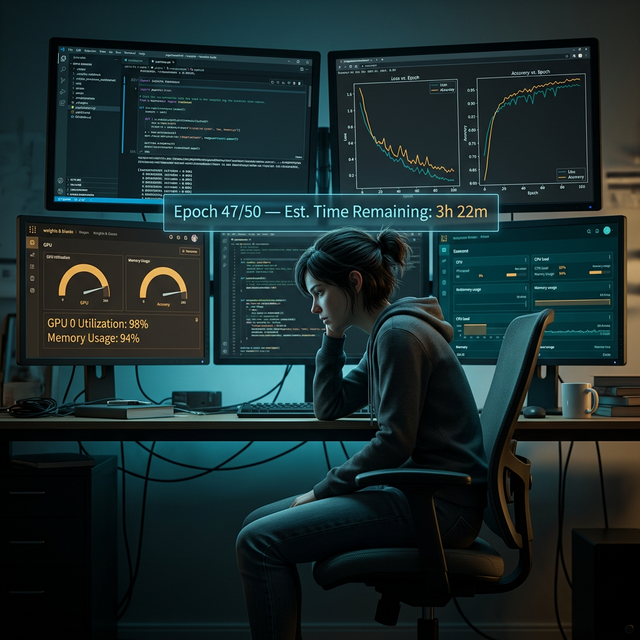
In machine learning, overfitting is the process of training a model so aggressively on a specific dataset that it loses any capacity to generalize. The model memorizes noise and becomes catastrophically brittle when exposed to real-world data. There is a direct biological equivalent happening inside the bodies of data scientists in 2026—and the training data is a chair. After years of exquisitely optimizing your neural networks, your own body has been quietly overfitting to the static, sedentary posture of a Jupyter Notebook session. The result is a biological model that performs perfectly in one specific environment (sitting at a desk) while failing spectacularly in every other context—from basic walking to restful metabolism. This is not a metaphor. It is a metabolic reality with catastrophic, evidence-based downstream consequences.
The unique danger for data scientists is not just sitting—it is the nature of the waiting. When you submit a GPU training job that will run for 8 to 14 hours, you enter what behavioural researchers now call a ‘Sedentary Anchor Window.’ Unlike a software engineer who might stand to attend a meeting or a DevOps engineer who rotates through on-call shifts, the data scientist is psychologically tethered to their workstation, monitoring loss curves and validation metrics through an interminable vigil. Research published in early 2026 confirms that post-pandemic IT workers in hybrid roles average 10.76 hours of sedentary behaviour daily, with approximately 3.72 of those hours in prolonged, completely uninterrupted sitting bouts. Data scientists are at the extreme end of this distribution — not because they want to be, but because their infrastructure demands it. According to a 2025 NIH study, excessive sedentary behaviour independently increases the odds of metabolic syndrome by 73%, regardless of leisure-time physical activity.
Table of Contents
- 1 1. The Insulin Sensitivity Crash: Your Body’s OOM Error After 3 Hours
- 2 2. Thoracic Kyphosis: The Posture Collapse Nobody Tracks in Tensorboard
- 3 Visualizing the Cascade: From GPU Submit to Metabolic Failure
- 4 3. The Cardiovascular Cost: Dropped Packets and Plasma Triglycerides
- 5 4. The Model Degradation Loop: How Metabolic Decline Corrupts Your Analytical Output
- 6 5. The Batch Normalization Protocol: Resetting Your Metabolic Baseline
- 7 6. The Hidden Variable: High-Acid Coffee and Oral Microbiome Disruption
- 8 7. The Generalisation Protocol: A Practical Framework to Reverse the Overfit
- 9 Conclusion: Regularise Your Biological Model Before It Reaches Zero Generalisation
1. The Insulin Sensitivity Crash: Your Body’s OOM Error After 3 Hours
In high-performance computing, an Out of Memory (OOM) error is not a gradual degradation—it is a discrete threshold event. Your CUDA processes are running cleanly, allocating memory incrementally, and then, at a specific saturation point, the entire process is killed by the OS. Insulin resistance in sedentary workers operates on a nearly identical threshold model. For the first 60 to 90 minutes of sitting, your body continues normal metabolic processing. It is burning glucose efficiently, managing blood sugar with appropriate insulin secretion, and maintaining adequate blood flow to the lower extremities. But around the 3-hour mark without postural change, a critical metabolic threshold is crossed. A 2026 study in Frontiers of Physiology confirmed that just three hours of continuous sitting significantly reduces whole-body insulin sensitivity. Your cells begin ignoring insulin’s signal to absorb glucose, precisely mirroring the way a GPU thread ignores a stale memory pointer. Glucose accumulates in the bloodstream. Insulin production increases to compensate. The pancreas begins to overproduce insulin to overcome receptor resistance—the biological equivalent of your application spawning memory-hungry subprocesses to compensate for a leak, until the OOM killer terminates everything.
📦 Ergonomic Essential: Herman Miller Embody Ergonomic Office Chair
The definitive ergonomic chair for IT professionals, featuring a pixelated support matrix that automatically conforms to the micro-movements of your spine.
Best For: Chronic lumbar compression and restricted circulation from 8+ hour continuous sitting sessions.
- Designed specifically for ‘focused ergonomic working posture’
- Lowers resting heart rate by improving tissue circulation
- Backed by a 24/7, 12-year warranty
The long-term consequence of repeated 3-hour-plus sedentary windows is Type 2 Diabetes—a condition where the body’s insulin signalling pathway is permanently corrupted. This is not a distant risk for a future version of you. Research shows that even young, active adults who sit for eight or more hours daily display elevated cholesterol ratios and BMI scores, which are the early-warning flags of severe systemic dysfunction. Using our Daily Calorie Calculator tool to monitor your daily energy balance is a necessary first step, but it does not address the root cause: the prolonged interruption of lipoprotein lipase (LPL) activity in your muscle tissue.
The Lipoprotein Lipase (LPL) Timeline: A GPU Job vs. Your Metabolism
| Time Sedentary | Metabolic Event | Hardware Analogy |
|---|---|---|
| 0–60 min | Normal LPL activity, efficient glucose uptake | Process running nominally, adequate memory allocation |
| 60–90 min | LPL activity begins declining in leg muscles | Thread starts missing cache — latency increases |
| 3 hours | Insulin sensitivity drops measurably, LPL suppressed 50%+ | OOM threshold crossed — kernel swap activity spikes |
| 6+ hours | HDL cholesterol drops, triglycerides accumulate | Process killed by OOM watchdog — full cluster restart needed |
| Daily Repeat | Metabolic syndrome onset, adipose accumulation | Corrupted model weights — retraining from scratch required |
2. Thoracic Kyphosis: The Posture Collapse Nobody Tracks in Tensorboard
Every machine learning engineer obsessively tracks loss curves, gradient norms, and validation accuracy across every experiment. Tensorboard displays hundreds of metrics in real-time. Yet there is one continuously degrading metric that no one is monitoring: thoracic spine curvature. While you are staring at epoch 47 of 50, your thoracic spine is undergoing a slow, gravitational collapse known as Thoracic Kyphosis—an exaggerated forward rounding of the upper back that is now being classified by physiotherapists as a distinct occupational hazard for data scientists and ML engineers.
The mechanism is straightforward: when you lean forward to read loss metrics on a monitor, your head moves approximately 2.5 cm in front of your body’s centre of gravity. At this angle, the effective gravitational load on your cervical spine increases from its natural 5 kg to between 12 and 27 kg, depending on the degree of forward flexion. Over thousands of hours of GPU vigils, this compressive load remodels the vertebral discs and shortens the anterior chest muscles. The result is a permanent postural compensation: rounded shoulders, compressed thoracic vertebrae, and a forward head position that reduces lung capacity by up to 30%, further impairing the oxygen delivery critical for sustained cognitive performance. A properly specified ergonomic chair with dynamic lumbar support is not optional hardware for a data scientist—it is a critical instrument that prevents the biological equivalent of running your training job with a corrupted data loader.
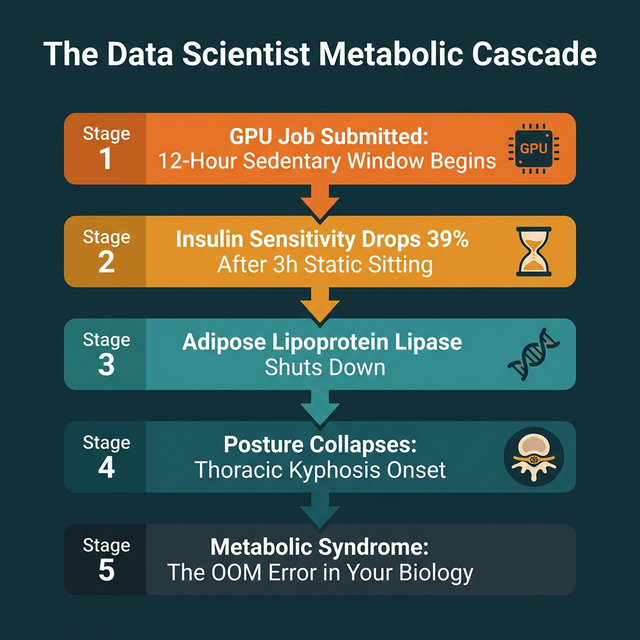
Visualizing the Cascade: From GPU Submit to Metabolic Failure
The following infographic maps the precise biological sequence that unfolds across a standard 12-hour GPU training job for a data scientist who remains stationary throughout. Note how each stage gates the next — this is not independent degradation, but a cascading failure model where an intervention at any stage arrests the downstream consequences.
3. The Cardiovascular Cost: Dropped Packets and Plasma Triglycerides
The American College of Cardiology has published definitive evidence that prolonged sedentary behaviour independently elevates cardiovascular mortality risk, separate from physical inactivity outside of work. Sitting for extended periods reduces circulation in the lower extremities, causing plasma triglycerides to accumulate in the bloodstream and HDL (‘good’) cholesterol levels to drop. This combination—high triglycerides and low HDL—is the signature metabolic marker of cardiovascular disease onset. For a data scientist running multiple daily training jobs across distributed GPU clusters, the cumulative cardiovascular load across a year of work is equivalent to a persistent network degradation event where packet loss is slowly increasing and throughput is progressively declining—but no one has configured a health monitoring alert to fire when the threshold is breached.
Critically, a 2026 cross-intervention study confirmed that reducing sitting time by as little as 30 minutes per hour significantly improves insulin sensitivity and metabolic flexibility within just two weeks of implementation. This is the equivalent of a zero-cost configuration change that dramatically improves system throughput. The challenge for data scientists is behavioral, not technical: the psychological anchor of an in-progress experiment actively discourages movement, even when the biological cost of remaining stationary is objectively catastrophic. Monitoring your Modern BMI score is a useful baseline measurement, but the more critical metric is waist circumference—the direct proxy for visceral adipose accumulation that correlates most strongly with cardiometabolic risk.
4. The Model Degradation Loop: How Metabolic Decline Corrupts Your Analytical Output
This is the feedback loop that no data scientist wants to confront: the sedentary behaviour that your role demands is actively degrading the cognitive machinery you need to do your role effectively. Chronic insulin resistance reduces glucose delivery to the prefrontal cortex—the exact region of the brain responsible for hypothesis generation, statistical reasoning, and experimental design. When your prefrontal cortex is operating in a glucose-depleted state, you make systematically worse decisions: you choose shallow hyperparameter sweeps over principled architecture changes, you rationalize stopping early instead of running longer ablations, and you miss the subtle covariance patterns in your validation data that signal distribution shift. Your model is not the only thing overfitting. Your brain—degraded by chronic metabolic dysfunction—has also overfit to the path of least cognitive resistance.
The literature on this feedback loop is unambiguous. Studies from MIT’s AgeLab and independent research teams consistently show that decreased cardiovascular fitness—a direct downstream effect of extended sedentary windows—is associated with measurably lower scores in executive function, working memory capacity, and processing speed. These are not abstract neurological metrics. They are the precise cognitive instruments you use when debugging a training instability, designing a novel loss function, or interpreting a confusing ablation result. Investing in your metabolic health is not orthogonal to your career as a data scientist—it is a force multiplier on the quality of your research output. Monitoring your sleep quality score simultaneously provides the final piece: deep sleep is when the hippocampus consolidates the complex statistical patterns you have been trying to model all day. Metabolic dysfunction destroys sleep architecture, closing the learning loop entirely.
5. The Batch Normalization Protocol: Resetting Your Metabolic Baseline
In deep learning, Batch Normalization is a technique that normalizes the inputs to each layer, preventing internal covariate shift and dramatically stabilising training dynamics. Your metabolism requires an analogous normalization process—specifically, structured periods of caloric restriction that allow insulin levels to fully clear and lipoprotein lipase to resume baseline activity. Time- restricted eating, commonly known as intermittent fasting, is the most clinically validated method for restoring insulin sensitivity in sedentary populations. A 2025 systematic review across 14 randomised controlled trials demonstrated that 16:8 intermittent fasting reduced fasting insulin by an average of 28% in overweight sedentary workers, independent of caloric deficit.
The implementation for a data scientist is precise and algorithmically simple: align your eating window with your active GPU monitoring hours to prevent mindless high-glycaemic snacking during idle training epochs. Do not eat within 3 hours of your scheduled sleep time to allow nocturnal growth hormone secretion—the primary anabolic hormone responsible for muscle preservation during sedentary periods—to operate without insulin interference. Use our Intermittent Fasting Planner to design your specific eating window based on your training schedule and wake time. Pair this protocol with a minimum of two 10-minute walking intervals per training job — triggered automatically by a cron job or calendar reminder tied to your experiment management system.
6. The Hidden Variable: High-Acid Coffee and Oral Microbiome Disruption
Data scientists consume coffee at the same institutional scale as all engineers — but with a specific additional risk vector. Unlike DevOps engineers who may pace during an incident, or software engineers who refill their mug while walking to a colleague’s desk, the data scientist often sits with a mug perpetually within arm’s reach, drinking passively across the full duration of a training run. This creates an environment of continuous, low-level oral acid exposure. The mouth’s pH drops below the critical 5.5 threshold—the point at which enamel demineralization begins—for extended, uninterrupted periods. Unlike an acute acid load that the salivary bicarbonate buffer system can neutralise, chronic low-level exposure depletes these buffers permanently, leading to accelerated enamel erosion, increased caries risk, and systemic inflammation from a degraded oral microbiome.
⚡ Editor’s Choice: ProDentim Oral Microbiome Optimizer
A chewable probiotic containing 3.5 billion CFUs of clinical strains designed to repopulate the oral microbiome, which is frequently degraded by high-acid environments.
Best For: Coffee breath, dry mouth, and enamel wear from consuming 4+ cups of ‘developer fuel’ daily.
- Restores beneficial bacteria killed by constant coffee intake
- Neutralizes acidity to protect tooth enamel
- Reduces gum inflammation without harsh mouthwash chemicals
The connection between oral microbiome health and metabolic syndrome is now well-established. Pathogenic oral bacteria produce lipopolysaccharides (LPS)—endotoxins that enter the bloodstream through inflamed gum tissue and trigger systemic, low-grade inflammation. This chronic, low-level inflammatory state is a known potentiator of insulin resistance. In other words: your coffee- saturated oral microbiome is not just degrading your teeth. It is actively worsening the metabolic dysfunction caused by your sedentary GPU training windows. Monitoring your daily caffeine intake intake is the first intervention—but actively restoring the oral bacterial ecosystem through targeted probiotic supplementation is the clinically validated solution that addresses the root cause.
7. The Generalisation Protocol: A Practical Framework to Reverse the Overfit
In ML, we prevent overfitting through regularisation: L1 and L2 penalties, dropout layers, early stopping criteria, and data augmentation. The biological equivalent requires an equally multi-layered strategy. A single intervention—just ‘going for a walk’—is the equivalent of adding dropout alone and expecting it to solve a fundamentally overparameterised model. The following multi-signal regularisation framework is derived from the 2026 literature on sedentary intervention strategies for knowledge workers.
The first regularisation layer is mandatory postural interruption. Every 45 to 60 minutes of GPU job monitoring, execute a 5 to 10-minute standing or walking protocol. This is not a ‘break’—it is a scheduled background process that runs in parallel with your experiment. Set a system-level notification using your OS scheduler. The second layer is nutritional normalisation: implement a structured eating window using the Intermittent Fasting Planner to prevent blood glucose instability during sedentary periods. Avoid high-glycaemic index snacks during training runs. The third layer is neuro-acoustic regulation: the cognitive fatigue generated by staring at loss curves for 6+ hours is a real neurological phenomenon driven by depleted dopamine and serotonin precursors. Structured audio protocols that shift the brain from high-frequency Beta to restorative Theta states can compress the cognitive recovery time between experiment cycles from hours to minutes.
Conclusion: Regularise Your Biological Model Before It Reaches Zero Generalisation
The most sophisticated ML systems in the world are trained using rigorous validation sets, cross-validation, and out-of-distribution testing to ensure the model can generalise beyond its training data. Your biological system deserves the same engineering discipline. Right now, the 12-hour GPU training window is your training dataset — and your body has overfit to it with near-perfect precision. Joint mobility has degraded because you never need to move. Insulin sensitivity has collapsed because glucose is never consumed by active muscles. Thoracic curvature has collapsed because the chair provides all the structural support your core muscles have stopped providing.
Every epoch your model trains is an opportunity cost your musculoskeletal system is paying. The sedentary window is not a neutral event — it is an active training signal reinforcing biological damage. The practical solution is not to stop training models. It is to architect your work environment with the same rigour you apply to your model’s hyperparameter search: structured interruption schedules, metabolic monitoring checkpoints, and — critically — targeted interventions that address the oral microbiome’s role in amplifying systemic inflammation. Your next model will not be trained by an overfit, metabolically compromised version of you. Regularise now.
Disclaimer: The content on TheHealthyTechPro is for educational purposes only and does not constitute medical advice. Consult a qualified healthcare professional before making health-related decisions. This article contains affiliate links; we may earn a commission at no additional cost to you, which supports our ability to continue producing high-quality, research-backed content.