
By The Healthy Tech Pro Editorial Team | June 2026 | 12-minute read
At a glance: Coding copilots and generative models promise near-instantaneous output, but they have shifted the engineering bottleneck from manual typing to intense, continuous verification. This shift introduces a silent, systemic biological tax known as “Metabolic Drift.” Discover the science behind how AI-augmented workflows affect Heart Rate Variability (HRV), Interkey Interval (IKI) latency, and cellular energy budgets—and how you can design an automated recovery stack to keep your human hardware running smoothly.
Table of Contents
- 1 The Copilot Paradox: When Typing Stops and Verification Drains Your Brain
- 2 What is Metabolic Drift? The Human Metaphor for Memory Leaks
- 3 The Biological Observability Stack: Biometrics of the Brain
- 4 The Metabolic Drift Mitigation Protocol: Implementing Your Personal SRE Plan
- 5 A Systematic Approach to Developer Longevity
The Copilot Paradox: When Typing Stops and Verification Drains Your Brain
In the tech industry’s rush to automate every aspect of software engineering, we have fallen prey to a classic systems-design error: optimizing the output rate of a single component while ignoring the cascading load it places on the downstream orchestrator. The orchestrator, in this case, is the human engineer. Generative AI models, interactive IDE agents, and autocompletion tools can compile thousands of lines of boilerplate code in a single second. The marketing materials promise that this saves developers from the “tedium” of syntax, freeing them to focus on architecture. However, the reality of working in an AI-augmented environment in 2026 is that developers are facing unprecedented levels of cognitive exhaustion, a phenomenon often described as “AI Brain Fry.”
The root cause of this fatigue is the shift in cognitive modality. Writing code from scratch is a constructive process. It operates linearly, allowing the brain’s prefrontal cortex to construct logical relationships incrementally. Verification, on the other hand, is a deconstructive, analytical process. When you verify code written by an AI agent, you must read the code, mentally simulate its execution path, check for subtle logical regressions, identify potential security flaws, and confirm that the integration points conform to your existing codebase. This is neurologically far more demanding than writing code. It forces your working memory to simulate an alien execution model while hunting for errors that are often deceptively subtle. As we explored in our piece on AI Reviewer Fatigue, this “verification loop” places a massive cognitive tax on the developer’s brain, turning what should be a productive sprint into a high-fatigue scanning marathon.

According to research from the Boston Consulting Group, while developers using generative AI tools completed tasks up to 40% faster, their subjective stress levels and physiological markers of autonomic strain rose by nearly 18%. The developer is no longer a creator; they have been demoted to a manual compiler and debugger of machine output. This continuous state of evaluation leads to a severe drain on our mental resources, manifesting as a slow, cumulative slide in biological performance that we define as Metabolic Drift.
What is Metabolic Drift? The Human Metaphor for Memory Leaks
In software engineering, a memory leak occurs when a program allocates memory on the heap but fails to release it back to the operating system after use. At first, the system continues to run smoothly. But over time, the unreleased allocations accumulate, reducing the available RAM, increasing page-swapping activity, and eventually leading to a complete system lockup or a kernel panic. Metabolic Drift is the physiological equivalent of a memory leak within the human operating system.
When you work in a traditional environment, you have natural pauses: you wait for a local build to compile, you pause to look at a whiteboard, or you walk over to chat with a colleague. These pauses represent biological “garbage collection” cycles, allowing the prefrontal cortex to clear its working memory buffers, flush adenosine buildup, and restock cellular energy stores (adenosine triphosphate, or ATP). In an AI-augmented coding environment, however, these natural pauses are eliminated. The moment your copilot finishes a line, it suggests the next one. The moment you push to main, a CI/CD agent kicks off automated checks, writes automated PR comments, and prompts you to review them immediately. The cycle is continuous, offering no downtime.
This persistent flow forces the brain into a state of continuous partial attention. The prefrontal cortex is never allowed to fully down-regulate. The constant stream of micro-decisions—confirming an autocomplete suggestion, verifying a variable name, deciding whether to accept a refactoring recommendation—silently depletes the brain’s finite chemical resources. As your cortisol levels remain elevated, your body’s sympathetic nervous system stays in a low-grade fight-or-flight state. This state gradually redirects metabolic energy away from deep recovery and cognitive maintenance toward immediate survival responses. Like a memory leak, Metabolic Drift is silent. You don’t feel a sudden crash. Instead, your cognitive bandwidth slowly shrinks, your error rates rise, your physical posture collapses, and your sleep quality degrades, eventually leading to a systemic crash.
The Biological Observability Stack: Biometrics of the Brain
To prevent a memory leak from crashing a production server, we implement monitoring tools like Datadog, Prometheus, or Grafana. We set alerts on heap usage, CPU throttling, and request latency. To prevent Metabolic Drift from compromising our physical and mental health, we must implement a similar Human Observability Stack. We cannot manage what we do not measure. By tracking specific, evidence-based biometric signals, we can detect the onset of cognitive fatigue hours before we consciously experience burnout.
1. Interkey Interval (IKI) Jitter: Keyboard Telemetry
Most developers view their keyboard as a simple input peripheral. In clinical neuropsychology, however, keyboard interaction is recognized as a highly sensitive window into the motor-cognitive system. The primary metric of interest is the **Interkey Interval (IKI)**—the time elapsed, measured in milliseconds, between successive keystrokes. When your brain is fresh and operating at peak cognitive capacity, your IKI is highly rhythmic and predictable. The typing cadence shows a stable distribution with minimal variance.
As cognitive fatigue sets in, the motor-cortex execution becomes erratic. This instability is measured as **IKI Jitter**. Decision fatigue slows down the transition between typing clusters (such as typing keywords like `function` or `import`), leading to micro-pauses. Additionally, your delete-key frequency spikes. When you are tired, you make more typing errors, and you spend more time correcting them. By monitoring your IKI variance and delete-key patterns, custom IDE plugins or keystroke telemetry tools can flag cognitive overloading with remarkable accuracy. In our guide on AI Burnout Prediction, we outline how these HID diagnostics serve as a real-time warning system for developers.
2. Heart Rate Variability (HRV) Collapse: Autonomic Observability
Heart Rate Variability is the variation in time intervals between consecutive heartbeats, measured in milliseconds. Unlike heart rate, which simply counts beats per minute, HRV provides a direct window into the balance between the sympathetic (fight-or-flight) and parasympathetic (rest-and-digest) branches of your autonomic nervous system. A high HRV indicates a highly adaptive, resilient nervous system that is ready to handle stress. A low HRV indicates that one branch is dominating—typically the sympathetic system—suggesting that your body is under stress and failing to recover.
When you are deep in a high-stress verification cycle, checking AI-generated code under tight deadlines, your HRV will begin to collapse. Your heart transitions from an organic, irregular rhythm to a rigid, metronomic beat. This is the physiological equivalent of CPU thermal throttling: your body is trying to preserve its core functions by reducing system adaptability. A study published in BMC Public Health confirmed that a drop in daytime HRV correlates directly with an increase in cognitive fatigue and preceding burnout states by up to 72 hours. Utilizing wearables like the Apple Watch, WHOOP, or Oura Ring to monitor your HRV trends provides a reliable, early-warning signal for when your biology is slipping into a critical state.
3. Glucose Stability: Fueling the Human Processor
The human brain is a highly inefficient processor: it accounts for only 2% of your body weight but consumes over 20% of your resting metabolic energy, primary in the form of glucose. High-intensity cognitive work, such as verifying complex code logic and managing context switches, dramatically increases the brain’s local glucose demands. In a sedentary developer, this creates a unique metabolic vulnerability.
When you consume high-glycemic carbohydrates or multiple cups of sweetened coffee, your blood glucose spikes. This is followed by an insulin surge, which clears the glucose from your bloodstream, leading to a sharp crash. During this glucose crash, the available energy for your prefrontal cortex drops precipitously. The result is a sudden onset of brain fog, irritability, and a collapse in problem-solving speed. By using a Continuous Glucose Monitor (CGM), developers can see that their 3:00 PM slump is often not a lack of sleep, but a direct consequence of a glucose crash. Maintaining a flat glucose curve through proper nutrition and timing is essential for sustained focus. You can evaluate your own metabolic habits using our Daily Caffeine & Sugar Intake Calculator to understand how your diet impacts your daily cognitive output.
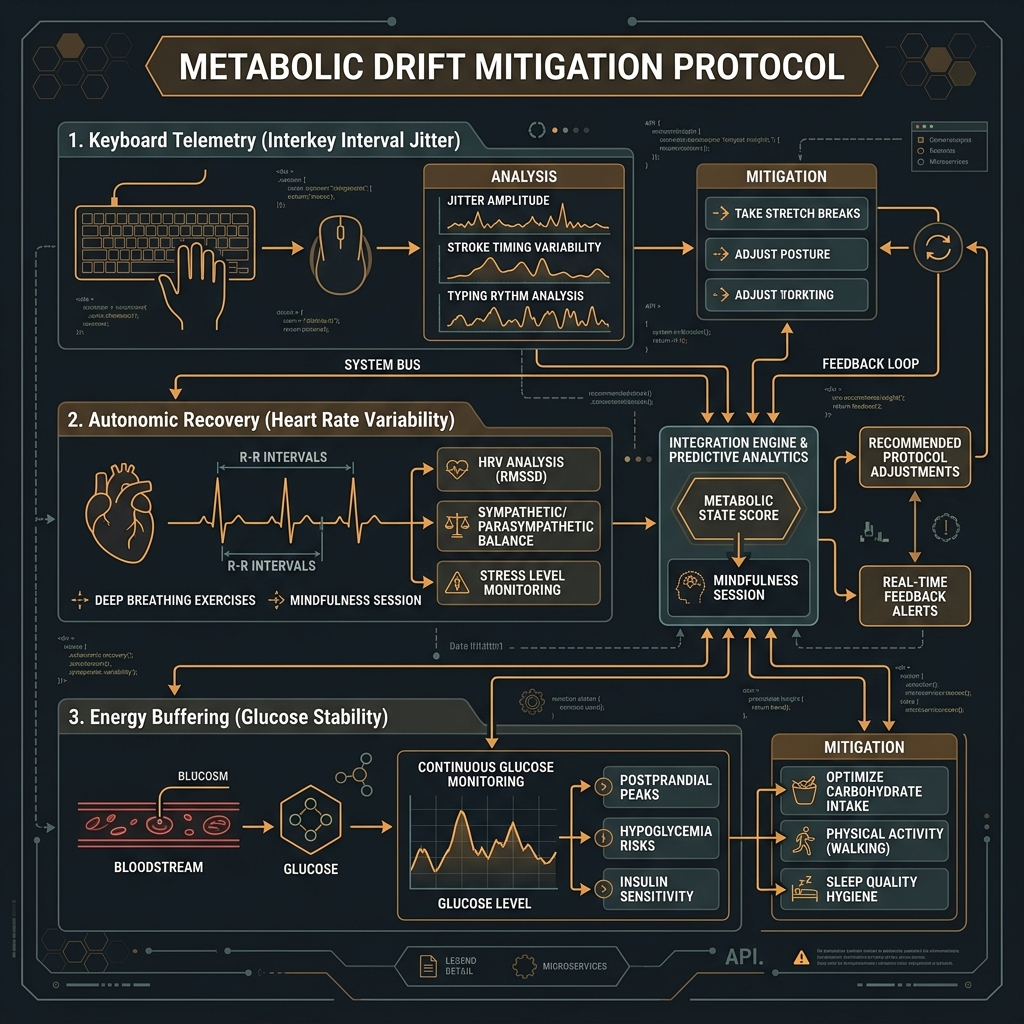
The Metabolic Drift Mitigation Protocol: Implementing Your Personal SRE Plan
Once you have implemented your Human Observability Stack, you must define the automated remediation protocols. Just as a Site Reliability Engineer (SRE) writes runbooks to auto-heal a cluster when a service goes down, you must establish clear, non-negotiable protocols to auto-heal your own biology. This is the **Metabolic Drift Mitigation Protocol**.
Layer 1: Cognitive Load Balancing (The 90-Minute Compile Cycle)
The human brain operates naturally on ultradian cycles—biological rhythms of roughly 90 to 120 minutes during which our alertness, focus, and energy peak, followed by a 15-to-20-minute valley. Pushing through these natural valleys by drinking more caffeine or staring harder at the screen is the biological equivalent of overclocking a processor without adequate cooling: you get a brief burst of speed at the cost of long-term hardware degradation.
To implement Cognitive Load Balancing, divide your workday into strict 90-minute blocks. During these blocks, focus intensely on a single task, minimizing context switching. When the block ends, you must initiate a 15-minute recovery phase. This is not a time to check social media or read emails; those activities continue to drain your prefrontal cortex. Instead, step away from screens, walk around, or perform deep breathing exercises. If you want to estimate the cost of your current context-switching habits, try our Context-Switch Cost Calculator to see how much energy you are losing to fragmented focus.
Layer 2: Defragmentation Breaks (Garbage Collection for the Mind)
When you are constantly reading and verifying code, your short-term memory accumulates temporary variables, logic paths, and stress hormones. To clear this cognitive cache, you must run a “garbage collection” process. The most effective way to do this is through **Non-Sleep Deep Rest (NSDR)** or specialized audio protocols.
NSDR is a science-backed protocol that guides the nervous system into a state of deep physical relaxation while maintaining mental alertness. By shifting your brain wave activity from high-frequency Beta waves (associated with active work and stress) to lower-frequency Alpha and Theta waves (associated with recovery and creative insights), NSDR allows your brain to rapidly restore ATP levels and clear cortisol. A 20-minute NSDR session in the afternoon can restore your cognitive capacity to near-morning levels, clearing the accumulated fog of Metabolic Drift. To assess your current fatigue levels and determine if you need an immediate defragmentation break, use our Cognitive Fatigue Score Calculator.
Layer 3: Circadian Architecture (Optimizing Your Biological Schedule)
Your body’s internal clock, or circadian rhythm, regulates everything from your body temperature and hormone release to your sleep-wake cycle and cognitive peak windows. Failing to align your work schedule with your circadian biology is a major source of metabolic friction. DevOps engineers on-call rotations are a prime example of this struggle, as detailed in our analysis of the DevOps Sleep Crisis.
To optimize your circadian architecture, schedule your most demanding cognitive tasks—such as code verification, architectural design, and complex debugging—during your natural cognitive peak, which typically occurs 2 to 4 hours after waking. Use your afternoon dip for administrative work, meeting participation, or lower-friction tasks. To ensure your sleep architecture is supporting your cognitive needs, audit your sleep using our Sleep Quality Calculator. Aligning your daily work blocks with your chronotype is the most efficient way to reduce the biological friction of engineering, as detailed in our guide on Circadian Rhythm Optimization for Software Engineers.
Layer 4: Physical Offloading (Ergonomic Circuit Breakers)
Cognitive fatigue is not purely mental; it is deeply connected to your physical environment. Sitting in a slouched position for hours at a time restricts your diaphragm, reducing oxygen intake, and increases gravitational load on your spine. This physical strain sends distress signals to your brain, further elevating cortisol levels and compounding your cognitive fatigue. In our Cybersecurity and Cortisol Stress Management guide, we trace how physical tension accelerates cognitive decline under pressure.
To break this loop, implement physical circuit breakers. Every 45 minutes, stand up, stretch your chest, and reset your gaze. Keep your monitor at eye level to prevent forward head posture, which can add up to 30 pounds of extra load on your cervical spine. If you spend your entire day sitting, you can evaluate your physical risks using our Sedentary Risk Calculator to see how physical stagnation is contributing to your Metabolic Drift.
A Systematic Approach to Developer Longevity
The tech industry’s obsession with raw speed is unsustainable. The introduction of AI copilots has increased our output velocity, but it has also dramatically increased the cognitive load on the human developer. As developers, we must treat our own biology with the same engineering discipline that we apply to our software systems.
Stop managing your health manually. Implement your Human Observability Stack, track your IKI and HRV, stabilize your glucose, and automate your recovery protocols. By building a robust defensive stack, you can mitigate the effects of Metabolic Drift and protect your most valuable engineering asset: your mind.
Related Resources:
- AI Burnout Prediction: Are You Being Throttled? A Biometric Guide for Devs
- The Reviewer Fatigue Epidemic: How AI Code Review Is Overloading Senior Engineers
- The DevOps Sleep Crisis: On-Call Culture and Cognitive Collapse
- Circadian Rhythm Optimization for Software Engineers
- Cortisol, Stress & Cybersecurity: Why the High-Stakes Environment Is Breaking Your Brain
Medical Disclaimer: The information provided in this article is for educational and informational purposes only and is not intended as medical advice. Always consult with a qualified healthcare professional before making any changes to your health regimen, bio-hacking protocols, or using new wearable devices.